The next leg on the way to Key West was a stop at Rodriguez Key about 40 miles away. To keep out of the bigger waves off shore we decided to go down the Hawk Channel. The channel is part of the Intercoastal Waterway (ICW) that is inside the reef that separates Florida from the Atlantic ocean. The channel is well marked and of sufficient depth. The thing about the Hawk Channel is that during crab season it is full of crab pots. Tons of crab pots. These things are strung out in rows and rows, each row is marked with a different color of float to identify the owners. Each float is attached to the crab pot by a nylon rope. The last thing we wanted to do was get the prop tangled in that rope. It seems weird that the fisherman would string these things across the ICW. It would seem that the large tugs and barges cruising down the ICW would just mow them down, but I guess not. And another thing. Why would you have a crab pot that is painted black? Or worse, white? If there is even a small amount of wind, every little breaking wave looks like a crab pot. Or a Portuguese Man-o-War (stinging jellyfish with some kind of balloon/airbag thing attached). The majority of our day was spent motoring and dodging crab pots, jellyfish, and breaking waves.
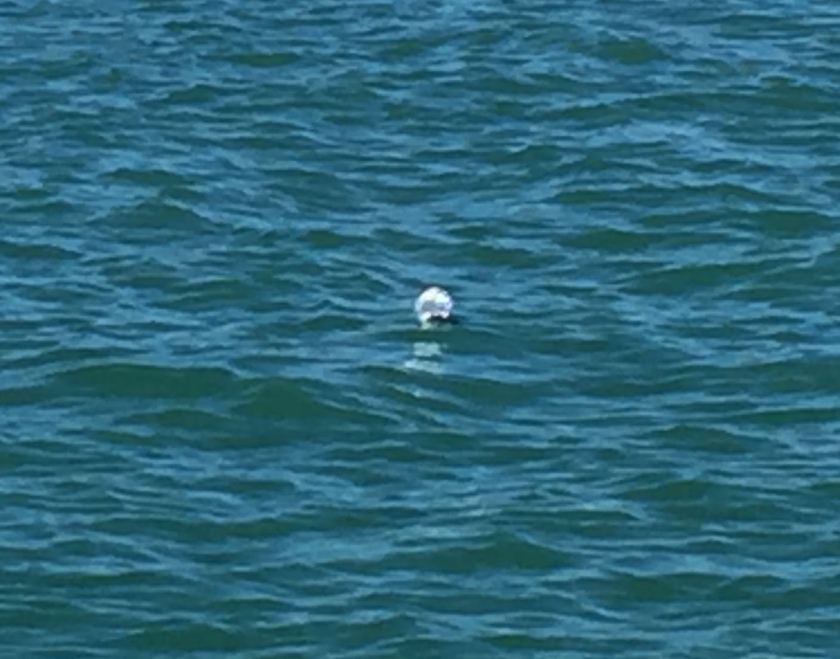
Portugese man-o-war 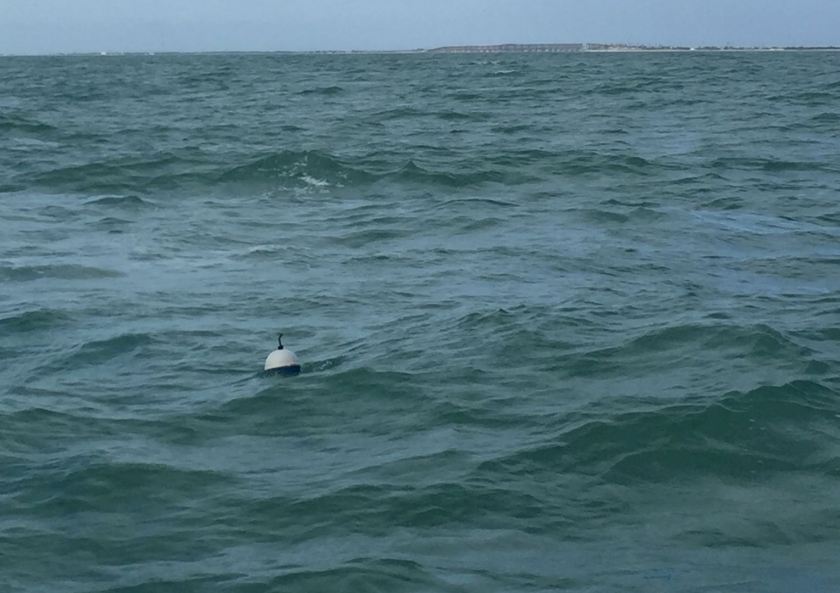
Crab pot
We anchored for the night in a semi-protected anchorage behind Rodriguez Key. Rodriguez Key gives good protection from the wind when it is out of the south or southeast, not so much when it comes from the east or northeast. The weather was starting to turn cloudy and the wind was beginning to pick up, but, it was from the south and it wasn’t uncomfortable. Until the anchor alarm went off.
An anchor alarm is basically a GPS “fence” that you set up when you anchor and it alerts you if you move too far from where you actually set the anchor. This can happen if the wind or current gets too high and you begin to drag the anchor, which is what we were doing. At 4:00 a.m. The thing about anchor alarms is that they never seem to go off when afternoon when you first set the anchor, even if it is windy. They always seem to go off in the middle of the night.
Fortunately, I am a pretty light sleeper. I think Jan could sleep through a gale, but me, at the first little sound or change in the way the boat is moving, and I am instantly alert. I woke up just before the anchor alarm went off. It is always disorienting when you look out and, because the wind has shifted 180 degrees from where it was when you went to sleep, the boat is pointed in a totally different direction. The wind was out of the northeast and Rodriguez Key wasn’t offering much protection from the chop blowing in off the Atlantic . And, I could see that the lights in the near distance were moving relative to those in the far distance, a sure sign that the boat was moving. Fortunately, the anchorage was large and we were in no immediate danger of running aground. I woke Jan, and started the engine, and motored to keep us in place. When Jan was up and could take control the boat I hauled up the anchor and we tired to reset it. We tried four times and every time we could not get it to hold. We finally gave up as the sky was beginning to show the first light of dawn. We started heading to our next destination, Marathon Key, picking our way through the crab pots in the dim, pre-dawn light.
Once we were safely tied up at Marathon Marina one of the first things I did was to look up the recommended size of the anchor for Distant Drummer. It turns out that the anchor that came with the boat was at least one and maybe two sizes too small. We ordered the new anchor the next day.

 Distant Drummer
Good for you, cousin! Living your dream. Stay safe. Will look forward to your blog.
LikeLike
Glad you are both ok! If it is not one thing it is another when boating.
LikeLike